Professor Hardwigg
A Journey to the Centre of the EarthProfessor Hardwigg is Henry's German uncle, a professor whose command of many sciences and forceful temperament turn Saknussemm’s cryptic document into an expedition to the Earth’s interior. He is at once the journey’s principal theorist and its stubborn champion: he treats evidence as a reason to proceed where conventional teaching counsels impossibility, yet his encounters with unfamiliar facts repeatedly reveal the gap between scientific authority and explanation. The expedition makes his convictions famous, but the reversed compass remains a problem he cannot solve.
Identity and Temperament
Hardwigg is a professor of philosophy, chemistry, geology, mineralogy, and numerous other subjects. He has invited his fatherless nephew Henry to study with him, and their household is also a working scientific space: one day, after Henry has spent hours in the laboratory, Hardwigg rushes in from outside and summons him before he can attend to his hunger. His entrance establishes the force with which he occupies both home and investigation.
Henry describes his uncle as choleric and original, and says that bearing with him means obeying. Hardwigg’s heavy steps and stamping foot give that authority a physical presence. Yet the same man is capable of exuberant excitement: when he identifies Arne Saknussemm’s name on the nearly erased parchment, he cries out joyfully, recognizes him as a celebrated sixteenth-century Icelandic alchemist, and imagines that the document may conceal a profound discovery. His abrupt shifts from command to wonder are central to his character.
From the Parchment to the Expedition
Hardwigg’s determination takes decisive form when he realizes the cryptogram must be read backward. He snatches up the document and reads the deciphered message, abandoning his earlier frustration at its apparent meaninglessness. The discovery does not remain an antiquarian puzzle: he immediately orders Henry to prepare both their portmanteaus, insisting that they start at once. Henry is horrified and resolves to argue against the journey, but Hardwigg’s discovery has already become a practical undertaking.
Henry’s objections are scientific as well as personal. He argues that established teaching makes a descent to the Earth’s centre impossible and points to the expected increase of heat underground. Hardwigg answers that he cares nothing for theories when they conflict with the precedent of Saknussemm: another traveller, he reasons, has succeeded, so he may do so as well. His position is not simply a rejection of evidence; it is a preference for the precedent supplied by the parchment and for the possibility that direct experience will overturn accepted models. But his confidence often turns disagreement into command, as when he cuts off Henry’s calculations rather than answering them.
Authority, Observation, and Dispute
Hardwigg’s scientific manner combines measurement, field observation, and a pronounced confidence in his own interpretations. During the approach to a possible volcanic eruption, he reads the behavior of the steam vents as evidence of safety: because their activity has not intensified, he says, an immediate eruption is not to be feared. When Henry begins to question him, Hardwigg closes the discussion by treating science as a verdict to be obeyed. The scene shows how his appeal to scientific authority can reassure, but also silence, his nephew.
Underground, the objects of observation increasingly resist easy dismissal. Henry points out fossil traces on the walls and produces an almost perfect shell. Hardwigg identifies it as a trilobite, an extinct crustacean, but Henry presses him to draw a larger conclusion from the find. Later, when the travellers examine a fish, Henry proposes that it is a small sturgeon. Hardwigg studies its flat head, rounded body, bony scales, toothless mouth, unusually developed pectoral fins, and lack of a proper tail before deciding that it belongs to an ancient family known from Devonian fossils. The careful examination illustrates the empirical competence behind his authority, even as the discoveries make the familiar boundary between fossil record and living world less secure.
The tension between theory and observation becomes explicit in Hardwigg’s disputes with Henry about depth and heat. Henry points out that they have descended sixteen leagues, near the limit science allows for the thickness of the Earth’s crust, and calculates that their temperature should be about fifteen hundred degrees on the Réaumur scale. The thermometer instead registers 27.6 degrees. Hardwigg treats that reading as a decisive refutation of the expected proportional increase in temperature and invokes Humphry Davy in support of his confidence. Henry offers a competing explanation: the lava surrounding the extinct volcanic chimney might conduct heat poorly, while the hot-water jet supports his interpretation. He does not pursue a prolonged argument, choosing to accept the measurements without accepting his uncle’s inference.
Their disagreement also concerns how evidence licenses a conclusion. Henry calculates that the underground route’s horizontal distance would carry them far southeast before they could reach the centre. Hardwigg dismisses the calculation’s premises, asks whether the passage might lead directly to their destination, and returns to Saknussemm as his precedent. The exchange gives the expedition its recurring intellectual pattern: Henry tests claims against measurements, geology, and direction, while Hardwigg treats the journey itself and its extraordinary precedent as grounds for continuing.
Persistence and Care
Hardwigg’s determination is not only an abstract commitment to discovery; it shapes decisions when the expedition is close to failure. During the water crisis, Henry tries to force Hans to leave, but Hardwigg intervenes and tells him that he will accomplish nothing by coercing his devoted follower. He identifies the lack of water as the sole obstacle to his project, explains that he has reconnoitred another gallery while Henry lay unconscious, and argues that its downward course should lead to granite and springs. He offers a limit as well as an argument: one more day to find water, after which he will abandon the enterprise and return to the surface. Henry recognizes the effort it costs his uncle to make this concession and yields.
Hardwigg’s confidence in the evidence can also make him cautious. After Henry has been ill, Hardwigg does not let him rush immediately into the open air, insisting that he take precautions first. His care sits beside his impatience: he drives the expedition onward, but does not treat Henry’s physical recovery as irrelevant. This qualification matters to their relationship, which is shaped by sharp disagreement but also by family attachment and responsibility.
Return, Reputation, and the Unresolved Compass
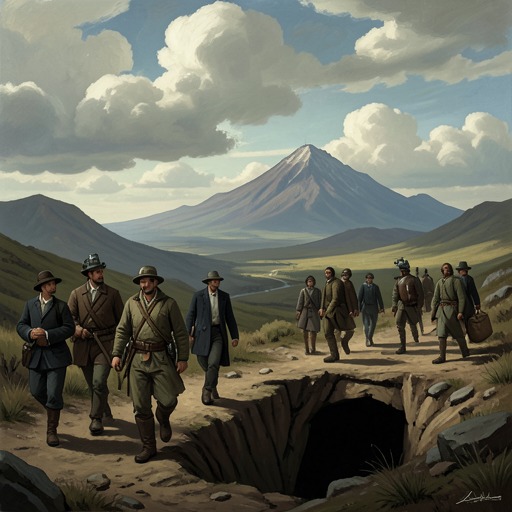
Reaching land at the edge of the underground sea does not satisfy Hardwigg’s ambition. He is delighted to have reached the shore, but explains that this is not the end of the expedition: the travellers are to resume their overland journey and try again to penetrate toward the Earth’s centre. The distinction between a successful arrival and a completed objective defines his persistence. The expedition ends without the full penetration he had sought, yet he does not present its discoveries as a reason to abandon the underlying question.
Back in Hamburg, Hardwigg’s return creates a public sensation. Because Martha had disclosed his departure, the story of the expedition has spread widely; at first, people do not believe it, and seeing him return safely makes them still more incredulous. Hans’s presence and fragments of information gradually change public opinion. Hamburg then holds a festival in honor of Hardwigg and Henry, and a public meeting of the Johanneum Institution hears Hardwigg relate their adventures. He omits the facts connected with the compass, the one episode that continues to defy his account.
Hardwigg deposits Saknussemm’s document in the town archives and expresses regret that circumstances prevented him from following the Icelandic traveller’s track all the way to the centre. His modesty amid growing fame does not prevent the expedition from drawing envious opponents. Because his theories and supporting observations challenge the accepted account of central heat, he defends his views in writing and speech against learned critics. Henry continues to believe in central heat, while allowing that poorly understood circumstances may require existing laws to be modified. Their difference survives the journey rather than being settled by fame.
The compass remains Hardwigg’s private scientific frustration. For six months it lies unnoticed and untouched, but its inexplicable behavior still preys on his mind; a learned man, the narrator observes, finds it aggravating to be baffled by such a phenomenon. The return therefore leaves two legacies in tension: public recognition for an expedition Hardwigg cannot fully repeat or explain, and an instrument whose failure keeps the limits of his knowledge visible. His character is defined by the force that carries him beyond received theory—and by the unanswered evidence that force cannot master.